59 Welby Street, Grantham, Lincolnshire, NG31 6EA
Free measuring and quoting, no obligation
01476 593199

Real wood flooring in Grantham, supplied and fitted

There are two kinds and the difference is important, so this page spends most of its time on that.

Est. 1993, over 30 years in the trade Measured and fitted by our own team

Nothing imitates wood quite well enough to fool anyone standing on it. A real timber floor has depth, grain and variation that a printed layer can't reproduce, and it ages into something better rather than something worn out.

Which one for your house

Your house
Choice 1

Choose engineered if you have underfloor heating

This isn't a preference, it's close to a rule. Solid wood doesn't conduct heat well and it shrinks and moves with the temperature cycling. Engineered handles it. If you've got underfloor heating and someone offers you solid wood, ask them why.

Choice 2

Choose engineered if the room's conditions vary

Kitchens, rooms with big windows, anywhere that swings between warm and cold.

Choice 3

Choose engineered if you want wide planks

Wide boards in solid timber move a lot. Engineered stays flat.

Choice 4

Choose solid if you want the maximum number of refinishes over decades, and the room is stable and dry

A solid plank can be sanded back several times over its life.

Choice 5

Choose solid if it's a period property and you want the floor to be what it appears to be, all the way down

Worth being honest about the refinishing argument, because it gets overplayed. Solid wood can be sanded more times than engineered, yes. But a quality engineered board with a 4mm or thicker wear layer can be sanded several times too, and most floors only need a full sand every fifteen years or so. For most people, in most houses, that's more refinishing than they'll ever use.

Which one for your house
The choice

Solid or engineered?

Both are real wood. The difference is in the construction, not the quality.

Solid wood is machined from a single piece of timber, typically 18mm to 22mm thick, the same species all the way through. Oak, walnut, ash and so on.

Engineered wood has a genuine hardwood top layer bonded onto a core of cross-bonded plywood. The surface is real oak or real walnut, identical to look at once it's down. The engineering is underneath.

That layered core is the whole point. It cross-braces itself, so the board moves far less with changes in temperature and humidity than a solid plank does. In a British house, with damp winters outside and central heating drying the air inside, that stability matters.

A note worth making plainly: engineered wood is not laminate. Laminate has a photographic print on a fibreboard core. Engineered wood has real timber on top. People conflate the two constantly and it isn't a fair comparison.
Book a Free Measure
Solid or engineered?
Day to day

Living with a wood floor

It marks. That's part of it, and if the idea of a dent from a dropped pan bothers you, wood may not be the right floor.

Keep grit off it, because grit under a shoe is what scratches a finish. Felt pads under everything. Mats at external doors.

Clean with a barely damp mop and a cleaner made for wood. No steam mops, no wet mopping, no general-purpose floor cleaner.

Try to keep indoor humidity reasonably stable. Very dry air in winter causes small gaps to open between boards, which close again as humidity rises. That's normal timber behaviour, not a fault.

Direct sunlight will lighten or darken most timbers over time. Move rugs occasionally so it happens evenly.

Book a Free Measure
Living with a wood floor
The fitting

Fitting and subfloors

Real wood is fitted in several ways depending on the product and what's underneath: floating over an underlay, glued directly down, or secret-nailed to battens or boards.

Whatever the method, two things have to be right.

Moisture. Timber and moisture are a bad combination. A concrete subfloor has to be dry, and dry means measured, not assumed. If the floor is a new screed, it needs to have dried properly first, which takes considerably longer than most people expect.

Acclimatisation. Wood needs to sit in the room it's going into, in its packaging, for a period before it's laid, so it settles to the humidity of the house. Skip this and the floor moves after it's down. It's the least exciting part of the job and it's not optional.

More about floor preparation and screeding →

Book a Free Measure
Fitting and subfloors
Limits

Where wood doesn't belong

Bathrooms, wet rooms and utility rooms. Neither solid nor engineered wants standing water, and neither will forgive it. If you want the look of timber in a bathroom, that's what LVT is for. About LVT →

Kitchens are a judgement call. Engineered wood in a kitchen is common and it works, provided spills get wiped up rather than left. Solid wood in a kitchen we'd be more cautious about.

What we stock

What we stock in the showroom

Samples on a screen are a guess. Samples in your hand, in daylight, are a decision. The showroom's on Welby Street, with free street parking nearby.

Our work

Recent work, in real houses

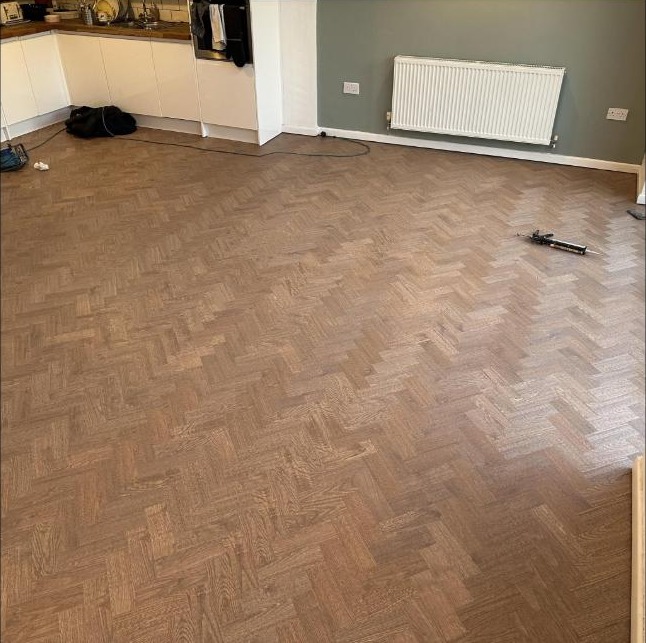
Every floor in this gallery is one of ours, laid in a real house, usually somewhere in or around Grantham. No stock photos, no show homes.

See All Our Work →
FAQ

Fast answers for busy households

The things people ring us to ask, answered plainly. If yours isn't here, call 01476 593199.

What's the difference between solid and engineered wood?

Solid wood is one piece of timber all the way through. Engineered has a real hardwood top layer over a cross-bonded plywood core. Both are real wood on the surface. Engineered is more stable, handles underfloor heating and copes better with changes in humidity.

Is engineered wood real wood?

Yes. The surface is genuine hardwood, the same species you'd get in a solid board. It's laminate that has a printed image rather than real timber, and the two are often confused.

Can you have wood flooring with underfloor heating?

Engineered wood, yes. Solid wood, generally not, because it doesn't conduct heat well and it moves too much with temperature cycling. If you have underfloor heating, engineered is the sensible choice.

Can engineered wood be sanded and refinished?

Yes, if the wear layer is thick enough. Roughly 1mm comes off per sanding, so a 4mm wear layer allows three or four refinishes, which for most households is a lifetime's worth.

Can wood flooring go in a kitchen?

Engineered wood can, and often does, provided spills are wiped up rather than left to sit. Bathrooms and wet rooms are a firm no for both types.

How long does a wood floor last?

A well-looked-after solid wood floor can last generations. A good engineered floor with a thick wear layer will last decades. Both outlive most other flooring types by a wide margin.

Do I need to acclimatise the wood before fitting?

Yes, and it's worth insisting on it. The boards need time in the room to settle to its humidity before they're laid. Skipping it is a common cause of gapping and cupping afterwards.

Why has my wood floor got gaps in winter?

Dry indoor air in the heating season shrinks timber slightly, and the gaps usually close again as humidity rises in spring. It's normal. Consistently large gaps or lifted edges are a different matter and worth having looked at.

Get started

Ready for a floor that lasts?

Get a free wood flooring quote. We'll come out, measure properly, bring samples if you want them, and give you a written quote. Free, and no obligation.

Real Wood Flooring fitted by Welby St. Carpets
Call 01476 593199